Mistakes to Avoid While Applying for Jobs in Dubai: Top 10 Common Issues
Applying for a role in Dubai is competitive; a few easy-to-fix mistakes can turn a promising application into a rejection. Below are the top 10 Dubai job application mistakes to avoid, why they matter, and practical fixes so you can stand out and get interviews faster.Many candidates often wonder why their Dubai job applications get rejected, even when they meet most job requirements. In reality, small errors in formatting, documentation, or relevance can quickly eliminate an application before it reaches a recruiter.
Quick checklist before you hit “Apply.”
Before submitting, ensure that your CV is tailored, the file name is professional, your LinkedIn profile matches your CV, your contact details are in international format (including a UAE number if you have one), and that you have read the job description closely.
1. Sending a generic CV and cover letter Recruiters in Dubai scan for relevance. Sending the same CV to every role looks crazy and is one of the main Dubai job application mistakes applicants repeat. Tailor your profile summary and bullet points to match the job’s keywords.
2. Wrong CV format (not UAE / ATS-friendly) Many applications never reach human eyes because applicant tracking systems filter poorly formatted CVs. Use a clean, reverse-chronological resume of 1–2 pages with clear section headings, and avoid elaborate graphics.
3. Missing UAE-specific details Omitting a clear phone number (including country code) or failing to note attested qualifications and visa status can trigger rejections. Recruiters often prefer candidates who signal UAE-readiness early in the CV.
4. Poor English, grammar, or inconsistent dates Typos, broken sentences, and mismatched employment dates reduce credibility. In a market where many roles require client-facing communication, clarity matters. Don’t let language errors be one of the Dubai job application mistakes that cost you interviews.
5. Incomplete or incorrect online profiles If your LinkedIn or portal profile contradicts your CV, recruiters will question your reliability. Ensure summaries, job titles, and dates match across platforms.
6. Ignoring the job description—mismatch of skills Applying without matching at least 60–70% of the listed skills is a quick route to rejection. Read the JD, mirror key phrases (honestly), and prioritize relevant achievements.
7. Unprofessional file names & attachments Files named “CV-final-NEW.pdf” look unprofessional. Use “FirstName-LastName-CV.pdf” and upload standard formats (PDF unless the employer asks for Word).
8. Not researching the company or culture Dubai employers value cultural fit and market knowledge. Generic interviews where the candidate hasn’t researched the employer raise red flags and increase the chance the application is rejected.
9. Overstating or falsifying information Background checks are standard in the UAE. Misstated dates, exaggerated roles, or unverifiable claims lead to immediate rejection and damage future prospects.
10. Visa and document mistakes that block offers Even after an offer, missing or incorrect documentation (expired passport, non-attested degrees, and previous visa issues) can cause job or visa rejections. Treat document preparation as part of the application process.
Common Dubai job rejection reasons—quick summary
Top reasons for rejection are non-tailored CVs, ATS failure, lack of UAE-relevant experience, poor English, conflicting online info, and incomplete documentation. Fix these and you eliminate most Dubai job rejection reasons.
2. Optimize for ATS: simple layout, standard fonts, and clear headings.
3. Network locally; reach out to recruiters and alumni in Dubai.
4. Prepare for interviews with UAE-specific examples and cultural awareness.
These simple moves directly answer how to increase job chances in Dubai and will improve call-back rates within weeks.
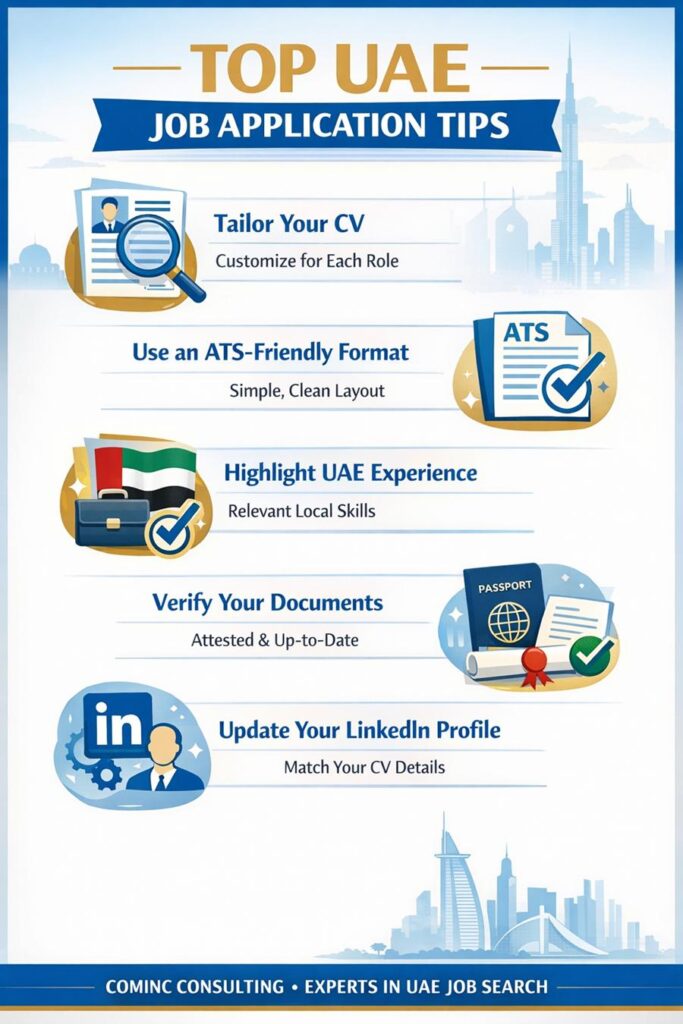
Top UAE job application tips — 6 quick wins
1. Keep CV concise: 1–2 pages.
2. Use UAE-friendly formatting and file names.
3. Match keywords from the job description.
4. Upload a clean, ATS-friendly PDF.
5. Make LinkedIn mirror your CV.
6.Double-check documents and attestations early.
Conclusion
Avoiding Dubai job application mistakes is chiefly about attention to detail and local know-how. At Cominc Consulting we specialize in CV optimization, ATS-friendly formatting, UAE-compliant documentation checks, and recruiter introductions so you don’t get screened out early. Our expert review targets the exact Dubai job rejection reasons hiring teams flag most often and gives you a step-by-step action plan to increase job chances in Dubai.
Need help polishing a CV or preparing for a Dubai interview? Cominc Consulting will review your application, tailor it for the UAE market, and coach you through every step from ATS-proof formatting to visa-document readiness.
Cominc Consulting: Turning Dubai job applications into interview invitations.
Frequently Asked Questions
Why do Dubai job applications get rejected so often?
Mostly because of non-tailored CVs, ATS formatting issues, missing UAE-specific details, or weak alignment with the job description.
How to increase job chances in Dubai when switching careers?
Emphasize transferable skills, obtain short certifications, and tailor your summary to reflect relevance.
Why do Dubai job applications get rejected despite relevant experience?
One of the main reasons why Dubai job applications get rejected is poor presentation rather than lack of experience.
What are the best UAE job application tips for first-time applicants?
Some of the most effective UAE job application tips include tailoring your CV for each role, using an ATS-friendly format, highlighting UAE-relevant experience, ensuring document accuracy, and keeping your LinkedIn profile aligned with your resume.