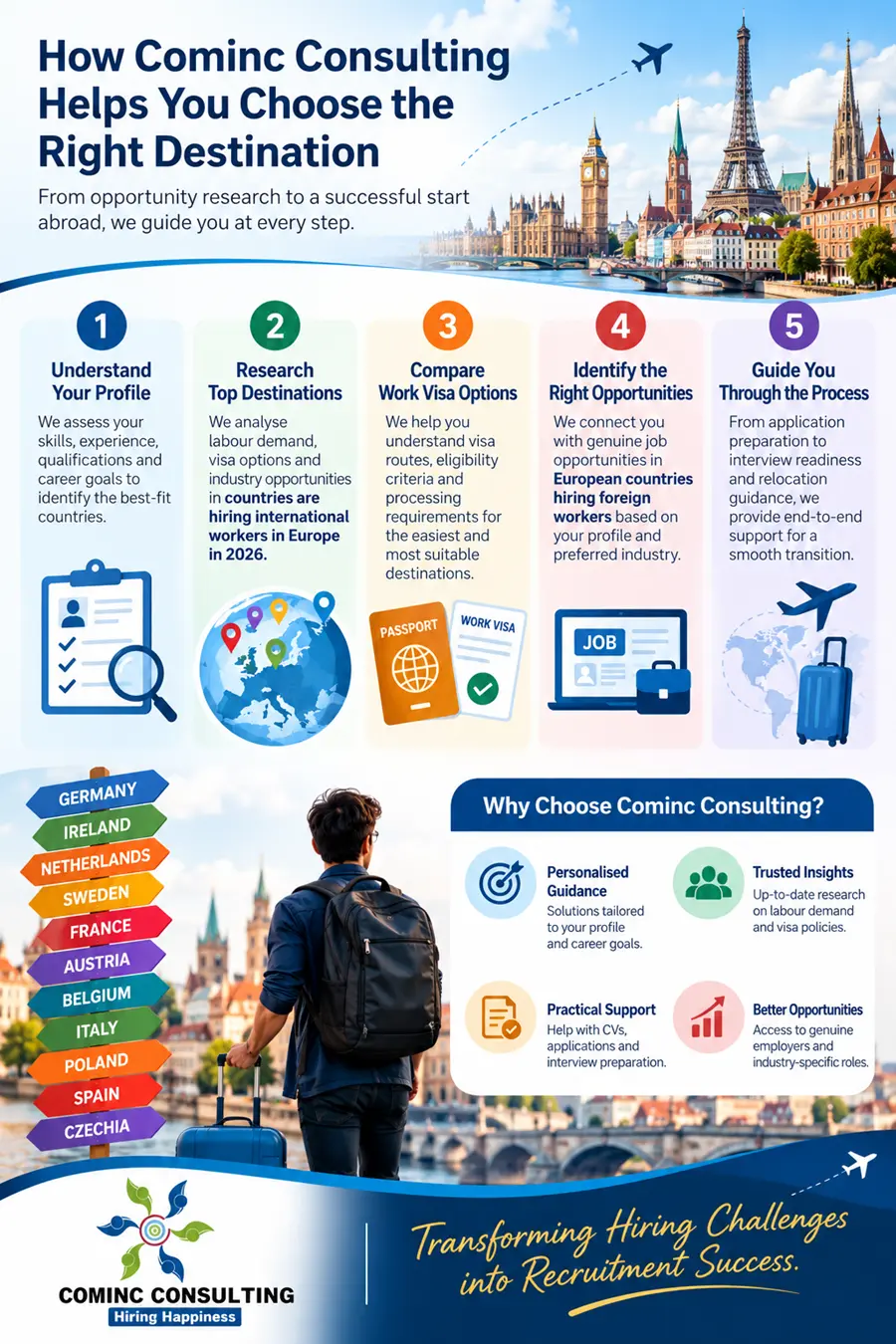
Professionals from Europe come to seek career advancement and experience abroad. Deciding on a destination involves a consideration of vacancies, work permits, language requirements and qualification recognition. Rules for permitting, language and hiring needs differ from country to country.
The report on labour shortages and surpluses by the European Labour Authority gives an overview of the challenges in recruiting. However, these shortages do not guarantee employment or visa: applicants will have to meet employer and immigration criteria. There are different eligibility rules for European countries hiring foreign workers. This guide highlights destinations worth researching.
1. Germany: Skilled and Technical Professions
Germany is an interesting destination for skilled trades and technical, engineering and construction jobs and healthcare. Skilled-worker permits, the EU Blue Card or job-search pathways are options eligible applicants can explore. It is important that qualification recognition and German skills be taken into account, particularly when working in regulated professions.
Germany is worth considering when your experience matches demand among the European countries hiring foreign workers.
2. Ireland: English-Speaking Workplaces
Ireland is a good destination for candidates seeking job opportunities in healthcare, construction, transport, technology and specialist business. It is a system with different types of employment permits, and eligibility for the employment permit is contingent upon the position, salary and applicable rules. English Language Appeal may be present, but there may be elements of competition and housing costs.
Countries hiring international workers in Europe include Ireland when an employer and role meet permit requirements.
3. Netherlands: Technology, Engineering and Logistics
Selected technology, engineering, research and logistics jobs are available in The Netherlands. There are some highly skilled migrant routes that need an employer who is recognized by the Dutch Immigration and Naturalisation Service (IND). Check salary rates, employment criteria and conditions of the sponsor. In some workplaces English will be used, and possibly Dutch will be used to increase choices.
There is also the possibility to join an organization in the Netherlands, if there are positions available for skilled workers who have the relevant previous experience.
4. Sweden: Skilled Employment
Sweden could be the ideal country for engineering, research, technology and healthcare graduates. Eligibility for work permits will be based on current regulations such as salary conditions and employment requirements. Read the information from the Swedish Migration Agency before accepting an offer.
5. France: Healthcare, Industry and Skilled Trades
France might be an option for jobs in healthcare, industrial, construction and engineering. French is a language that is commonly useful in patient-centred roles. Review employer expectations, qualification recognition and suitable work authorisation pathway. European countries hiring foreign workers may have different rules for the same profession.
6. Austria and Belgium: Technical and Professional Roles
There are paths available for qualified foreign workers, even for certain professions on the official shortage lists, in Austria. Opportunities in a few selected technical sectors and healthcare and industrial sectors are available in Belgium, with regional rules different in each region. Think both, if your profession fits into the needs of the local community not all vacancies are eligible for a permit. European countries hiring foreign workers apply different rules.
7. Italy, Poland, Spain and Czechia: More Destinations to Research
Italy may offer jobs in Healthcare, construction, and hospitality sector. Good options for manufacturing and logistics are Poland and Czechia, and for healthcare, construction and hospitality students, Spain is an option.
There are countries hiring international workers in Europe. Compare them on the basis of their occupations and permissions. Demand varies according to occupation and region. It is advisable to compare the Europe labour shortage 2026 with official vacancy portals and national employment services.
Which Countries Are Easiest for a Work Visa?
There is no universally easiest destination. The easiest European countries to get a work visa depend on your qualifications, occupation, job offer, salary and eligibility. The easiest European countries to apply for a work visa are those that have a good legal pathway for obtaining a visa and an available position.
Be wary of “easy visa” claims. Occupations that are short of the number of permits are not automatically eligible for a permit and regulations may be amended. The discussion on Europe labour shortage 2026 is helpful, but the formal checks for eligibility are important too. The easiest European countries to get a work visa differ from person-to-person.
The level of Europe labour shortage 2026 differs from country to country. Consider real jobs, and try to match your skills with the job. You can use a comparison of multiple destinations to make an informed decision.