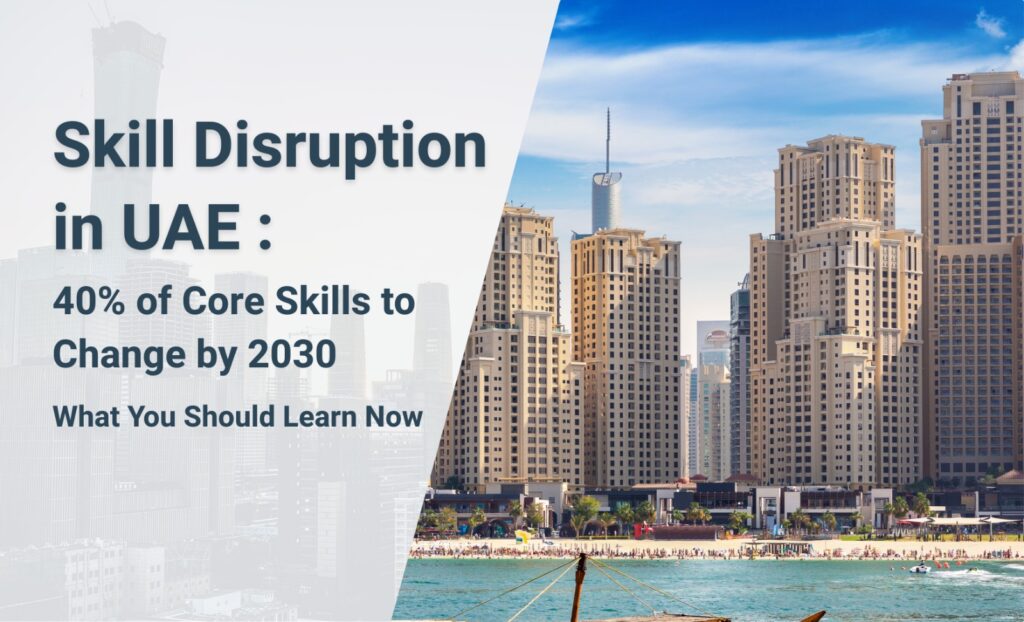
Skill Disruption in UAE: 40% of Core Skills to Change by 2030—What You Should Learn Now
The workplace has undergone rapid transformation, and skill disruption in theUAE is a primary challenge for professionals and employers. Leading global organizations’ estimates suggest that the introduction of AI, automation, the digital transformation of the UAE, sustainability mandates, and the UAE’s aggressive economic diversification will lead to a 40%change in core skills by the year 2030.
Already, the skills of professionals who are aware of future skills in the UAE will be better positioned for growth, competition, and staying relevant as companies move to cutting-edge technologies and ultra-modern operations. This article unpacks the UAE job market in 2030, explores the changing skills in the UAE, and highlights what you need to learn now to be a competitor.
Why Will 40% of Core Skills Change by 2030?
The UAE has a fast-growing economy that is set to be one of the most prepared for the future in the world. The government is focusing on AI, financial technology, logistics, sustainability, smart cities, and digital governance, and this has led to a tremendous shift in skill requirements.
Global insights predict:
– Over one-third of jobs will be affected by automation.
– AI will come with the need for employees to be proficient in a mix of digital and human roles.
– Readiness for sustainability laws will make it inevitable for companies to hire new staff to perform green jobs.
Skill disruption in the UAE has already gone beyond the realm of human resources and is now taking place in almost every sector of the economy, which professionals have to get ready for.
Future Skills in the UAE: What Employers Will Prioritise by 2030
Based on the UAE Skills Strategy, WEF Future of Jobs Report, and industry trends, here are the top future skills in the UAE shaping talent demand:
1. AI, Automation & Data Skills AI literacy, machine learning foundations, data analytics, and automation tools have become indispensable across all sectors. Digital skills combined with business decision-making will be required even in non-tech roles.
2. Digital Communication & Virtual Collaboration Remote work will always be here. Digital presentation, collaboration tools, and virtual communication are the main skills of the future in the UAE, which are the technologies that all people should acquire.
3. Cybersecurity & Digital Risk Management With the growth of digital ecosystems, organizations will demand personnel who are well-versed in the areas of data security, privacy policies, and threat mitigation, among others.
4. Sustainability & Green Skills Industries are moving towards green supply chains, renewable energy roles and sustainable operations in line with UAE Net Zero 2050, thus the practice of sustainability is deeply embedded in their operations.
5. Human-Centric Skills The process of automatization has made its way through; creativity, leadership, emotional intelligence, problem-solving, and adaptability have been ranked as the most changing skills in the UAE.
What You Should Learn Now: Skills That Will Not Expire
To navigate rising skill disruption in the UAE, professionals must start investing in future-proof capabilities today.
Here’s where to begin:
✔ Digital Skills
1. AI understanding
2. Data analytics & visualisation
3. Cloud tools
4. Automation platforms
✔ Business & Strategic Skills
1. Project Management
2. Agile frameworks
3. Business analytics
✔ Human & Behavioural Skills
1. Adaptability
2. Cultural intelligence
3. Collaboration
✔ Green & Sustainability Skills
1. ESG reporting
2. Resource efficiency
3. Green project management
These are core pillars of skills of the future in the UAE, applicable across industries.
Why Skill Disruption is Important for Employees and Employers
For the workers:
> Skill shortages will result in fewer promotions and career paths taken
> Unattractiveness to the tech-driven market
> Diminished chances of being recruited
For the managers:
> Inefficient workforce
> Unattractive offer for quality workforce
> Having to invest more in training and recruitment
Thus, to comprehend a future skill in the UAE will be a must for the career and not an option.
Conclusion
The UAE is progressing towards a future that is completely digital, sustainable, and skill-oriented. It is predicted that 40% of core skills will be different by 2030, thus making it necessary for professionals to accept the idea of lifelong learning and for companies to make structured workforce development their priority.
Understanding skill disruption in the UAE, preparing for the UAE job market in 2030, and focusing on future skills in the UAE will determine who thrives and who struggles in the next decade.
Cominc, with its profound market insight and strategic HR solutions, helps companies and workers to always be one step ahead of the changes and to seize the future of work with confidence.
Cominc Consulting: Transforming today’s talent into tomorrow’s future-ready workforce.
Frequently Asked Questions
What is skill disruption in the UAE?
Skill disruption refers to the rapid shift in required job skills due to AI, automation, and economic transformation. In the UAE, nearly 40% of core skills will change by 2030.
What are the most important future skills in the UAE?
Digital literacy, AI awareness, data analytics, cybersecurity, sustainability skills, and human-centric capabilities.
How will the UAE job market 2030 change?
The UAE job market will see increased demand for tech skills, hybrid roles combining human and AI tasks, sustainability-focused jobs, and more flexible hiring models.
Why are changing skills in the UAE important for businesses?
Companies that fail to upskill staff risk lower productivity, higher costs, and loss of competitiveness.
How can Cominc Consulting support career and workforce transformation?
Cominc offers tailored recruitment, talent development, skills assessments, and HR transformation services aligned with skills of the future in the UAE.